Best 3D Printer Enclosure (2026): Tents That Fit, Ventilation, and the Bambu A1 Question
The best 3D printer enclosures for home and apartment use: Creality, Elegoo and BIQU tents with maker sizes, how to vent one outdoors, and what Bambu says about enclosing the A1.
DisclosureWe may earn a commission when you buy through links on this site, at no extra cost to you. As an Amazon Associate we earn from qualifying purchases.
Our picks at a glance
| # | Product | Best for | Rating | Links |
|---|---|---|---|---|
| 01 | Creality 3D Printer Multifunction Enclosure | Best tent for most open printers | ||
| 02 | BIQU Panda Shelter | Best for Bambu Lab A1 and A1 mini | ||
| 03 | Elegoo 3D Printer Enclosure | Best for Elegoo Neptune printers | ||
| 04 | AC Infinity CLOUDLINE S4 Inline Duct Fan (4-inch) | Best fan for venting an enclosure outdoors | ||
| 05 | Flashforge Adventurer 5M Pro | Best alternative for apartments |
Creality 3D Printer Multifunction Enclosure
Three sizes with published dimensions and a model list per size, so it's easy to match to an Ender-style bed slinger. Creality describes the fabric as flame retardant.
- Type
- Soft tent enclosure on a frame
- Small
- 480 x 600 x 720 mm
- Medium
- 730 x 650 x 720 mm (some listings differ; check the size chart)
BIQU Panda Shelter
Made specifically for the A1 series with room for the AMS lite, and BIQU sells a matching ventilation kit. Read Bambu's heat warning below before you use one.
- Made for
- Bambu Lab A1 and A1 mini
- Type
- Soft, transparent-window tent enclosure
- Size
- 840 x 580 x 580 mm (as listed by BIQU retailers; confirm on biqu.equipment)
Elegoo 3D Printer Enclosure
Elegoo lists the usable inside space (550 x 650 x 750 mm), which makes fit checks simple. Viewing window, sealed cable port and storage pockets.
- Product size
- 570 x 670 x 770 mm
- Max machine space (incl. rack and tray)
- 550 x 650 x 750 mm
- Made for
- Elegoo Neptune 2, 2D, 2S, 3, 3 Pro, 4, 4 Pro
AC Infinity CLOUDLINE S4 Inline Duct Fan (4-inch)
A 4-inch inline fan with a 10-speed controller. Pair it with an enclosure that has a duct port to pull air out through a window vent.
- Duct size
- 4 in
- Airflow
- 226 CFM
- Noise
- 26 dBA
Flashforge Adventurer 5M Pro
Instead of tenting an open printer, an enclosed printer with a built-in dual-layer filter. Compact 220 mm build cube and a low-noise mode.
- Type
- Enclosed CoreXY FDM printer
- Build volume
- 220 x 220 x 220 mm
- Max nozzle temperature
- 280 °C
The best 3D printer enclosure for most people is a tent that matches your printer’s size, like the Creality Multifunction Enclosure (three sizes with Creality’s model list) or the Elegoo 3D Printer Enclosure (Elegoo lists 550 x 650 x 750 mm of usable space). For a Bambu Lab A1 or A1 mini, BIQU’s Panda Shelter is made for it, but Bambu advises against enclosing the A1 series because the base electronics can overheat. A tent blocks drafts and dust; it doesn’t remove fumes. For that, vent it outdoors with an inline fan like the AC Infinity CLOUDLINE S4, or choose an enclosed printer with a built-in filter.
3D printer enclosures compared
| Enclosure | Size (maker) | Made for | Vent option (maker) | Material claim (maker) |
|---|---|---|---|---|
| Creality Multifunction Enclosure | Small 480 x 600 x 720 mm; Medium 730 x 650 x 720 mm; Large 700 x 750 x 900 mm | Creality’s model list per size | Not listed on the pages we checked | Flame retardant, aluminum film lining |
| BIQU Panda Shelter | 840 x 580 x 580 mm (as listed by BIQU retailers) | Bambu Lab A1 and A1 mini, with AMS lite | Ventilation Kit sold separately | See BIQU’s page |
| Elegoo 3D Printer Enclosure | 570 x 670 x 770 mm outside; 550 x 650 x 750 mm max machine space | Elegoo Neptune 2, 3 and 4 series | Not listed | Flame-retardant aluminum foil Oxford cloth |
| AC Infinity CLOUDLINE S4 (fan) | 4-inch duct | Any enclosure with a 4-inch port | 226 CFM, 10-speed controller | n/a |
Creality’s Medium size appears with different numbers on some retailer listings, so check the size chart on Creality’s store before ordering. We couldn’t load BIQU’s own spec table, so confirm the Panda Shelter’s size on biqu.equipment.
Do you need an enclosure at all?
An enclosure is worth it if you:
- want to print ABS or ASA on an open printer that supports them (drafts cause warping),
- have a drafty spot, an AC vent or a cold garage,
- want to keep dust off the printer and pets or kids away from the hot nozzle,
- need a place to connect exhaust ventilation.
You probably don’t need one if you print PLA in a normal room. See open vs enclosed 3D printer for the full decision, including when an enclosed printer beats adding a tent.
What an enclosure does and doesn’t do about fumes
This is where most enclosure listings oversell. A tent around a printer contains air; it doesn’t clean it.
- A 2026 NIOSH study (O’Connor, Barnes, Dunn and Hammond, Atmospheric Environment: X) tested low-cost controls. A commercial, printer-specific partial enclosure captured as little as 28.6% of particles, because the printer’s cooling fans pushed emissions out of it. A full acrylic enclosure connected to a filtration unit captured at least 99.8%.
- NIOSH’s Science Blog post on 3D printing in an office lists ventilation as a key control: enclosed racks that vent outdoors, local exhaust connections, or HEPA filtration.
The takeaway: a tent helps only if it’s reasonably sealed and actively exhausted, either outdoors or through a filter. The same logic applies to resin printers; our resin printing in an apartment guide walks through the window-vent setup step by step.
3D printer enclosure with ventilation: how to set it up
- Choose an enclosure with a duct port, or one with a matching vent kit (BIQU sells a Ventilation Kit for the Panda Shelter). Neither Creality nor Elegoo lists a vent port on the tent pages we checked. If you plan to modify a tent, ask the maker first.
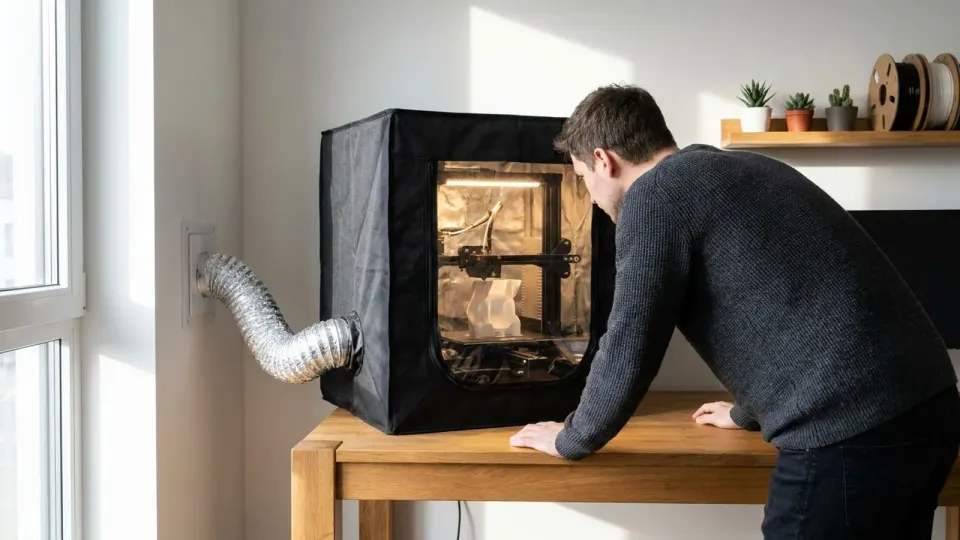
- Run a 4-inch duct to an inline fan, then to a sealed window vent. AC Infinity rates the CLOUDLINE S4 at 226 CFM and 26 dBA, with a 10-speed controller.
- Pull, don’t push. The fan should pull air out of the enclosure, so the tent sits at slightly lower pressure and leaks inward rather than into your room.
- Don’t overheat the printer. More enclosure isn’t always better: check your printer’s manual for its maximum ambient temperature and whether it should be enclosed at all (see the Bambu A1 section below).
3D printer enclosure for an apartment
Apartments add three constraints: no bedroom printing, limited venting and neighbors.
- Stick to PLA if you can’t vent outdoors. It’s the filament beginner printers are tuned for; see PLA vs PETG for beginners.
- Put the printer in a room nobody sleeps in, with a window you can open or vent through.
- Noise: panels and fabric may damp some sound, but the printer’s fans still run. If noise is the main concern, compare makers’ quiet-mode figures. Flashforge lists 50 dB in low-noise mode for the Adventurer 5M Pro.
- Consider an enclosed printer instead of a tent. An enclosed printer with a built-in filter (Flashforge lists a dual-layer filter on the 5M Pro; Elegoo lists HEPA plus activated carbon on the Centauri Carbon 2) is a tidier package than a tent and a fan. It still needs a ventilated room.
Bambu A1 enclosure: what Bambu says
This is one of the most-asked enclosure questions, and the honest answer is: Bambu doesn’t recommend it. On the Bambu Lab forum, a Bambu support reply says it’s “not recommended to place the A1 inside an enclosure, especially if it’s heated,” because the mainboard and power supply in the base can overheat, leading to print failures or damage over time. Bambu doesn’t sell an official A1 or A1 mini enclosure.
If you still want a cover for dust or drafts:
- Use a tent made for the printer, like the BIQU Panda Shelter, so the bed and AMS lite have room.
- Keep it vented (BIQU’s Ventilation Kit, or leave a panel open while printing) and never add a heater.
- Stay with PLA, PETG and TPU. Bambu lists ABS, ASA, PC and PA as not recommended on the A1 mini, so an enclosure doesn’t unlock those materials.
- If you want ABS or ASA, an enclosed printer is the better buy. Compare A1 mini vs Centauri Carbon 2.
The picks in detail
Creality Multifunction Enclosure: best tent for most open printers
Creality sells this tent in Small (480 x 600 x 720 mm), Medium and Large (700 x 750 x 900 mm), with a list of compatible printer models for each size. Creality describes a pure aluminum film interior and flame-retardant outer material. For reference, Creality lists its Ender-3 V3 SE at 420 x 366 x 490 mm; check Creality’s size chart for which tent it maps to, and leave room for the moving bed and spool holder.
Skip it if you have a Bambu A1 series printer. Get a tent shaped for it, and read the section above first.
BIQU Panda Shelter: best for Bambu Lab A1 and A1 mini
BIQU makes the Panda Shelter specifically for the A1 and A1 mini, and All3DP’s launch coverage says it’s big enough for the printer plus the AMS lite. Retailers list it at 840 x 580 x 580 mm. BIQU sells a separate Ventilation Kit for Panda Shelter; coverage of the launch describes it as a fan, tubing and an activated carbon filter, so check BIQU’s page for what’s included.
Skip it if you planned to enclose the A1 to print ABS. Bambu doesn’t recommend either.
Elegoo 3D Printer Enclosure: best for Elegoo Neptune printers
Elegoo lists an outside size of 570 x 670 x 770 mm and, more usefully, a maximum machine space of 550 x 650 x 750 mm including rack and tray. It’s made for the Neptune 2, 3 and 4 series. Elegoo lists flame-retardant aluminum foil Oxford cloth, a viewing window, a tightenable power-cord port, an inner mesh bag, a front pocket for a thermometer or hygrometer, and a foldable design. Elegoo doesn’t list a vent port.
Skip it if you need a ready-made exhaust connection.
AC Infinity CLOUDLINE S4: best fan for venting an enclosure outdoors
A 4-inch inline duct fan sold for grow tents, which use the same duct-to-window setup. AC Infinity lists 226 CFM, 26 dBA, 223 Pa static pressure and a wired 10-speed controller. It needs an enclosure with a 4-inch port (or an adapter) and a sealed window vent.
Flashforge Adventurer 5M Pro: best alternative for apartments
If you haven’t bought a printer yet, skip the tent. Flashforge lists an enclosed 220 mm build cube, a dual-layer filter system and a 50 dB low-noise mode. Bigger enclosed options are in the best 3D printer for teens and beginners, and the QIDI Q2 review covers an enclosed printer with active chamber heating for ABS and ASA.
What about Comgrow and DIY enclosures?
Comgrow sells Ender-sized fabric tents through marketplaces, but we couldn’t find a spec page on Comgrow’s own site, and listing sizes vary. If you buy one, check the inside dimensions against your printer. DIY enclosures (furniture-style cabinets, acrylic boxes) can work well and can be sealed better than a tent, but you take on the fire-safety and heat questions yourself. Follow your printer’s manual on ambient temperature.
How to measure for a 3D printer enclosure
- Measure the printer’s width, depth and height, including the spool holder and any top-mounted parts.
- On a bed slinger, add room in front and behind for the bed’s travel.
- Add space for multicolor units (AMS lite, CFS) and the filament path.
- Compare with the enclosure’s inside size or the maker’s model list, not just the outside dimensions.
- Plan the power cable and any duct route before you set it up.
Sources
- O’Connor C, Barnes C, Dunn KL, Hammond DR: “Design and Evaluation of Four Low-Cost Engineering Controls for Reducing Particle Emissions from 3D Printing”, Atmospheric Environment: X 30 (2026), 100432 (stacks.cdc.gov/view/cdc/258855)
- NIOSH Science Blog: “Characterizing 3D Printing Emissions and Controls in an Office Environment” (August 2018, cdc.gov/niosh)
- Bambu Lab forum: support reply on enclosing the A1 (forum.bambulab.com); Bambu Lab A1 mini tech specs (bambulab.com)
- Creality 3D Printer Multifunction Enclosure product page (store.creality.com); Creality Ender-3 V3 SE support page (creality.com)
- Elegoo 3D Printer Enclosure product page (elegoo.com)
- BIQU Panda Shelter and Ventilation Kit product pages (biqu.equipment); All3DP launch coverage of the Panda Shelter
- AC Infinity CLOUDLINE S4 product page (acinfinity.com)
- Flashforge Adventurer 5M Pro product page (flashforge.com)
How we tested
We haven't set up these enclosures ourselves or measured temperatures, noise or emissions. This guide compares the makers' own product pages (Creality, Elegoo, BIQU, AC Infinity, Flashforge) for size, fit and features, and uses NIOSH research and printer makers' guidance for the ventilation and heat questions. Where a maker page didn't give a figure, we say so. If we test an enclosure later, we'll add a dated hands-on section.
Frequently asked questions
Q1What is the best 3D printer enclosure?
The one that fits your printer and your goal. For most open bed slingers, a tent like the Creality Multifunction Enclosure (Small, Medium or Large, with Creality's model list) is the simple choice. For the Bambu Lab A1 or A1 mini, BIQU's Panda Shelter is made for that printer, but Bambu advises against enclosing the A1 series. If you want fume control, an enclosed printer with a built-in filter or an enclosure vented outdoors does more than a tent alone.
Q2Is a 3D printer enclosure good for an apartment?
A tent helps with drafts, dust and keeping pets away from the printer, and may damp some noise. It doesn't remove fumes unless it's sealed and vented outdoors or through a filter. NIOSH research found that a partial, printer-specific enclosure captured as little as 28.6% of particles. In an apartment, stick to PLA, keep the printer out of the bedroom and ventilate the room.
Q3Do I need a 3D printer enclosure with ventilation?
If you print ABS or ASA, or care about particles and fumes, yes. Ventilation means a fan pulling air out of the enclosure through a duct to a window, or through a filter. For PLA on an open printer in a ventilated room, an enclosure is optional.
Q4Should I put my Bambu A1 or A1 mini in an enclosure?
Bambu Lab's support team has said it doesn't recommend placing the A1 inside an enclosure, especially a heated one, because the mainboard and power supply in the base can overheat. If you use a tent for dust or drafts, keep it vented, never heat it, and stick to PLA, PETG and TPU, which is what Bambu recommends for the A1 mini anyway.
Q5Are fabric 3D printer enclosures fireproof?
Makers describe their tent fabric as flame retardant (Creality, Elegoo). That is a maker claim, and we didn't find a published fire rating on their product pages. An enclosure is not a substitute for supervision and a working smoke alarm.
Q6What size 3D printer enclosure do I need?
Measure your printer's width, depth and height, then add room for the moving bed (on a bed slinger), the spool holder and any multicolor unit. Compare that with the enclosure's inside size or the maker's model list. Elegoo, for example, lists 550 x 650 x 750 mm as the maximum machine space in its tent.