Best 3D Printer for Teens and Kids (2026): Enclosed, PLA-First Picks for Parents
The best 3D printers for teens and kids, chosen for parents: enclosed printers that keep hot parts out of reach, a compact pick for older teens, and a simple kids printer.
DisclosureWe may earn a commission when you buy through links on this site, at no extra cost to you. As an Amazon Associate we earn from qualifying purchases.
Our picks at a glance
| # | Product | Best for | Rating | Links |
|---|---|---|---|---|
| 01 | Elegoo Centauri Carbon 2 | Best enclosed printer for teens | ||
| 02 | Bambu Lab A1 mini | Best compact printer for older teens | ||
| 03 | Flashforge Adventurer 5M Pro | Best small enclosed printer | ||
| 04 | Toybox Alpha Three | Best for younger kids | ||
| 05 | QIDI Q2 | Best enclosed printer to grow into |
Elegoo Centauri Carbon 2
Fully enclosed with a glass door, a built-in camera and a 256 mm build cube. Room to grow into multicolor with Elegoo's CANVAS add-on.
- Type
- Enclosed CoreXY FDM printer
- Build volume
- 256 x 256 x 256 mm
- Max nozzle temperature
- 350 °C (hardened steel nozzle)
Bambu Lab A1 mini
Small, light and made for PLA, PETG and TPU. It's open-frame, so it suits teens who can be trusted around a hot nozzle.
- Type
- Open-frame bed-slinger FDM printer
- Build volume
- 180 x 180 x 180 mm
- Max hotend temperature
- 300 °C
Flashforge Adventurer 5M Pro
An enclosed 220 mm printer with a filter system and a low-noise mode, for desks where a bigger enclosed machine won't fit.
- Type
- Enclosed CoreXY FDM printer
- Build volume
- 220 x 220 x 220 mm
- Max nozzle temperature
- 280 °C
Toybox Alpha Three
A tiny PLA-only printer run from a phone or tablet app with a toy catalog. Simple, but too small for teens who want to design real parts.
- Print volume
- 75 x 80 x 90 mm
- Materials
- Plant-based PLA (Toybox lists it as PFAS and BPA-free)
- Extruder
- 0.4 mm
QIDI Q2
A bigger enclosed printer with chamber heating and an AI camera, for a teen who's serious about engineering projects.
- Type
- Enclosed CoreXY FDM printer
- Build volume
- 270 x 270 x 256 mm
- Max nozzle temperature
- 370 °C (bimetal hardened steel nozzle)
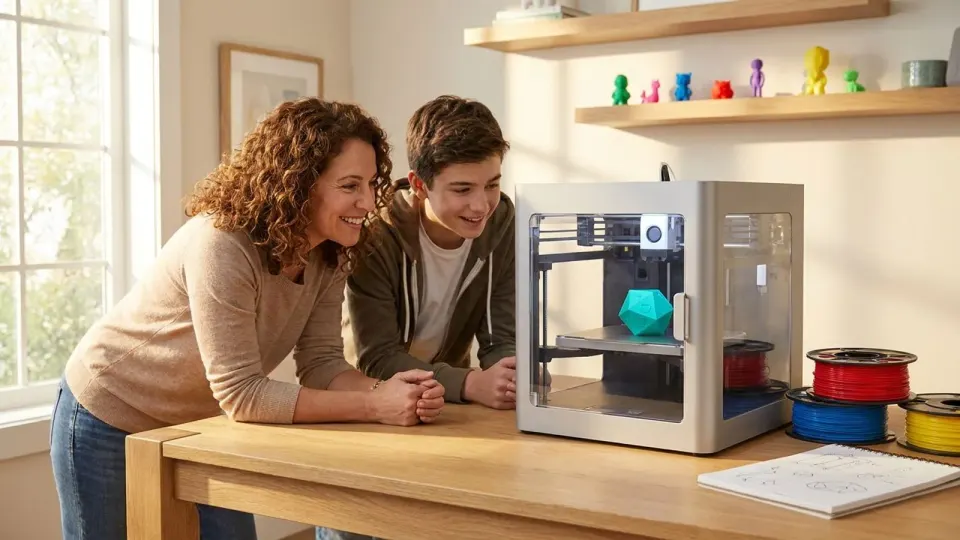
The best 3D printer for most teens is an enclosed one, because the hot nozzle and moving parts sit behind a door. Our pick is the Elegoo Centauri Carbon 2. For an older teen with limited desk space, the compact Bambu Lab A1 mini is a popular choice, but it’s open-frame. For younger kids, the Toybox Alpha Three is a simple, PLA-only printer run from a tablet app. Whatever you choose, start with PLA filament, set the printer up in a ventilated room, and supervise the first prints.
Teen and kids 3D printers compared
| Printer | Enclosed | Build volume (maker) | Max nozzle temp (maker) | Made for |
|---|---|---|---|---|
| Elegoo Centauri Carbon 2 | Yes | 256 x 256 x 256 mm | 350 °C | PLA, PETG, ABS, ASA, PC, TPU, some CF |
| Bambu Lab A1 mini | No | 180 x 180 x 180 mm | 300 °C | PLA, PETG, TPU (Bambu doesn’t recommend ABS/ASA) |
| Flashforge Adventurer 5M Pro | Yes | 220 x 220 x 220 mm | 280 °C | PLA, PETG, ABS, ASA (CF blends and TPU need a larger nozzle) |
| Toybox Alpha Three | Not stated by Toybox | 75 x 80 x 90 mm | Not listed | PLA only |
| QIDI Q2 | Yes, with chamber heating | 270 x 270 x 256 mm | 370 °C | PLA through engineering materials |
Specs come from each maker’s product page. A higher nozzle temperature isn’t a reason to print hotter materials at home with kids. It just means the printer can handle them later.
What parents should check before buying
Hot parts and moving parts
Every FDM printer melts plastic in a nozzle that runs at a couple of hundred degrees, and most heat the bed too. Bambu Lab’s A1 mini safety notes tell users not to touch the nozzle or heated bed while the printer is running, and to watch out for fast-moving parts. Elegoo’s manual says the same about the Centauri Carbon 2. On an enclosed printer, a door sits between curious hands and those parts. On an open-frame printer like the A1 mini, they’re exposed.
Before the first print, read the safety section of your printer’s manual together with your teen. Makers word their age and supervision notes differently, so follow the wording in the manual that comes with your machine.
Fumes, particles and where to put it
Printing melts plastic, so treat it like any hobby that makes fumes. Elegoo’s Centauri Carbon 2 manual says to run the printer in a well-ventilated area, and Bambu Lab’s PETG guide recommends a well-ventilated room or filtration. Two practical rules for families:
- Stick to PLA for kids. It’s the material beginner printers are tuned for. Our PLA vs PETG guide explains when PETG is worth it.
- Don’t put it in a bedroom where someone sleeps. A spare room, office or garage with a window is better.
An enclosure helps keep hands away, and some enclosed printers add filters (Elegoo lists HEPA plus activated carbon on the Centauri Carbon 2), but an enclosure isn’t a replacement for ventilation.
Apps and accounts
Most current printers are set up through the maker’s app or slicer software, which often needs an account. Toybox runs from a phone, tablet or browser with an optional subscription. Bambu Lab, Elegoo, Flashforge and QIDI use their own apps and desktop slicers. Each app’s terms of use set their own minimum age, so check them before your child signs up. A parent account is often the simplest way to handle this.
Size and noise
An enclosed printer takes up much more space than an open one. Measure the shelf or desk before you buy, and leave room around it. Elegoo lists under 45 dB for the Centauri Carbon 2 in its own Silent Mode test with PLA, and Flashforge lists 50 dB (low-noise mode) for the Adventurer 5M Pro. Makers measure differently, so treat these as rough guides.
The picks in detail
Elegoo Centauri Carbon 2: best enclosed printer for teens
The Centauri Carbon 2 is a fully enclosed CoreXY printer with a 256 x 256 x 256 mm build volume, a glass door and a built-in camera for watching prints from the app. Elegoo lists a 350 °C hardened steel nozzle, a 110 °C bed and a HEPA plus activated carbon filter. It’s ready for Elegoo’s CANVAS four-color system, which comes in the Combo or can be added later.
For parents, the enclosure is the main point. For teens, the big build plate and room to try multicolor mean it won’t feel limiting after six months.
Skip it if your space is tight. Elegoo lists the machine at 398 x 404 x 490 mm and 17.5 kg, so it needs a solid table.
Bambu Lab A1 mini: best compact printer for older teens
The A1 mini is a small open-frame printer with a 180 x 180 x 180 mm build volume. Bambu lists 347 x 315 x 365 mm and 5.5 kg for the machine, so it fits on a desk. It’s made for PLA, PETG and TPU; Bambu lists ABS and ASA as not recommended. Bambu also sells a Combo with the four-spool AMS lite for multicolor prints.
The catch for families: the nozzle, heated bed and moving bed are all exposed. It suits an older teen who follows safety rules, not a house with toddlers. Compare it head to head in A1 mini vs Centauri Carbon 2.
Skip it if younger siblings or pets can reach the desk.
Flashforge Adventurer 5M Pro: best small enclosed printer
The Adventurer 5M Pro is an enclosed printer with a 220 x 220 x 220 mm build volume, smaller than the Centauri Carbon 2 but still enclosed. Flashforge lists a dual-layer filter system, a built-in camera for remote monitoring and timelapse, a 4.3-inch touchscreen, interchangeable nozzles from 0.25 to 0.8 mm and a low-noise mode. Its manual gives the machine as 380 x 400 x 453 mm (without the spool holder) and 14.6 kg. It works with Flashforge’s own slicer and Orca Slicer.
Skip it if you want the biggest build plate for the space. The Centauri Carbon 2 prints larger parts.
Toybox Alpha Three: best for younger kids
Toybox is built for kids, not hobbyists. The Alpha Three prints PLA only, runs over 2.4 GHz Wi-Fi from a phone, tablet or browser, and comes with access to a catalog of ready-made toys. A subscription (Toybox Plus) is optional. Toybox lists a 75 x 80 x 90 mm print volume, 2.4 kg and a 7.5 x 7.75 x 9.5 in footprint.
That tiny print volume is the trade-off. A teen who wants to design cosplay parts, organizers or anything bigger than a toy will outgrow it fast.
Skip it if your child is a teen, or wants to learn real 3D design and slicing.
QIDI Q2: best enclosed printer to grow into
The Q2 is a bigger enclosed printer with a 270 x 270 x 256 mm build volume, active chamber heating up to 65 °C, a 370 °C nozzle, a filtration system and an AI camera for spotting failed prints. QIDI also lists a flame-retardant chamber, a PTC fuse and dual temperature sensors. It’s aimed at engineering materials that kids don’t need, but a teen heading into robotics or engineering won’t outgrow it.
Skip it if your teen is just starting out. The Centauri Carbon 2 covers the same PLA and PETG basics.
What else you’ll need
- Filament: a couple of spools of PLA to start. See PLA vs PETG for beginners.
- A filament dryer or dry box, once they move to PETG or TPU. See the best filament dryer.
- Flush cutters and a scraper for removing supports and prints. Our gifts for 3D printer owners lists the basics.
- A spot with ventilation away from where anyone sleeps.
Considering resin for miniatures instead? Resin needs more safety gear and ventilation than filament. Read can you resin print in an apartment before you decide.
Sources
- Elegoo Centauri Carbon 2 and Centauri Carbon 2 Combo product pages and FAQ (elegoo.com); Centauri Carbon 2 Combo manual
- Bambu Lab A1 mini tech specs (bambulab.com), A1 mini FAQ and PETG usage guide (wiki.bambulab.com), A1 mini safety notes
- Flashforge Adventurer 5M Pro product page (flashforge.com) and user manual (wiki.flashforge.com)
- Toybox Alpha Three product page (toybox.com)
- QIDI Q2 product page (qidi3d.com)
How we tested
We haven't tested these printers with our own kids or teens. This guide compares the makers' own specs, manuals and safety notes (Elegoo, Bambu Lab, Flashforge, Toybox and QIDI), focusing on what matters to parents: whether hot parts are enclosed, which materials each printer is made for, size and app setup. We don't describe print quality or reliability we haven't seen. If we test a printer later, we'll add a dated hands-on section.
Frequently asked questions
Q1What is the best 3D printer for a teenager?
For most families, an enclosed printer like the Elegoo Centauri Carbon 2 is the easiest choice, because the hot nozzle and moving parts sit behind a door. For an older teen with a small desk, the Bambu Lab A1 mini is a popular compact option, but it's open-frame.
Q2Is a 3D printer safe for kids?
With adult supervision and the maker's instructions, it can be. The nozzle and heated bed get hot enough to burn, and parts move fast. Printer manuals tell you not to touch them while printing and to run the printer in a well-ventilated area. An enclosure helps keep hands away, and sticking to PLA avoids the stronger-smelling materials.
Q3At what age can a child use a 3D printer?
There's no single rule. Follow the age and supervision notes in the printer's manual. Kids' printers like Toybox are built around an app and a toy catalog for younger children, while full-size hobby printers suit teens who can follow safety rules and are happy to troubleshoot.
Q4Should a kids 3D printer be enclosed?
Enclosed is the safer default for homes with younger children or pets, because the door keeps hands away from the hot nozzle and moving parts. It doesn't make fumes or particles disappear, so ventilation still matters.
Q5What filament should kids use?
PLA. It prints at lower temperatures than PETG or ABS and is what most kids' and beginner printers are made for. See our PLA vs PETG guide for when PETG makes sense later.
Q6Do kids need an account to use these printers?
Most current printers work best with the maker's app or slicer, which usually means an account. Check each app's terms for minimum age before you set it up, and consider using a parent's account.