Do You Need a Wash and Cure Station? (Resin Printing for Beginners)
You don't strictly need a wash and cure station, but you do need to wash and UV-cure every resin print. Station vs IPA containers, curing in the sun, 2-in-1 sizing and safe disposal.
DisclosureWe may earn a commission when you buy through links on this site, at no extra cost to you. As an Amazon Associate we earn from qualifying purchases.
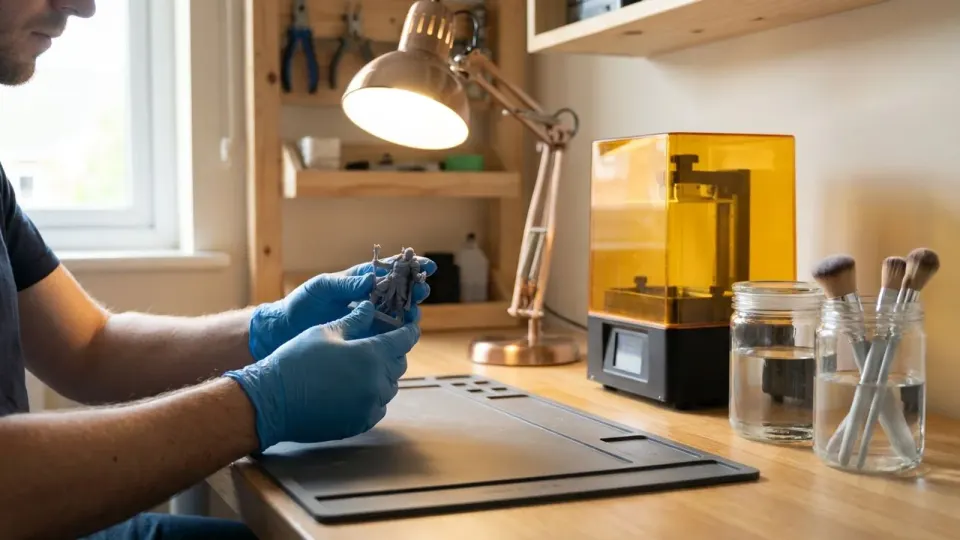
No, you don’t strictly need a wash and cure station, but you do need to wash every resin print in a solvent and then cure it under UV light. A station does both in one box: a sealed bucket of isopropyl alcohol (IPA) with a motorized wash, and a UV turntable with a timer. The alternative is two lidded IPA containers plus a separate UV light or sunlight. That works, but it’s messier and easier to get wrong. For a beginner in a home or apartment, a 2-in-1 station is the simpler and tidier choice. Match its size to your printer’s build plate.
Still picking a printer? Our best resin printers for miniatures pairs each 7- and 10-inch printer with a station that fits.
Why resin prints need washing and curing at all
A resin print comes off the build plate coated in liquid, uncured resin. Two steps turn it into a finished part:
- Wash. The leftover resin has to come off, usually in IPA (or water for water-washable resins). Otherwise it stays sticky and the details fill in.
- Cure. The print is only partly hardened when it leaves the printer. A dose of UV light (usually 405 nm, the same wavelength most resin printers use) finishes the job. Formlabs explains that post-curing completes the material’s properties and that heat speeds the process up.
Skipping either step leaves you with a part that’s still covered in, or made partly of, uncured resin. Elegoo’s product safety information for its photopolymer resin lists “Causes skin irritation”, “May cause an allergic skin reaction” and “Causes serious eye irritation”. So the washing and curing steps are part of handling resin safely, not just about how the print looks.
Wash and cure station vs IPA containers
| Wash and cure station (2-in-1) | IPA containers + separate UV light | |
|---|---|---|
| Washing | Motorized wash in a sealed bucket; some let you hang the whole build plate in the bucket | You swish or brush by hand, often in two containers (dirty, then clean IPA) |
| IPA exposure | IPA stays in one lidded bucket on the station | More open containers and more pouring, so more chances to spill and more vapor |
| Curing | Built-in UV LEDs on a turntable with a timer | A separate UV lamp, a DIY UV box, or sunlight |
| Consistency | Same light and timer every time | Depends on your lamp, distance and timing (or the weather) |
| Footprint | One box, but a big one (Anycubic’s 3 Plus is 434 x 312 x 267 mm) | Flexible, but containers and lamp add up |
| UV shielding | A cover; Elegoo says the Mercury Plus V3.0 stops curing when the cover is lifted | You have to shield an open UV lamp yourself |
| Best for | Beginners, small spaces, regular printing | Occasional prints, very large parts, people who already own a UV lamp |
The short version: containers do the same job for less gear, but a station makes the safe way the easy way. The IPA stays sealed, the UV light stays covered, and the timer stops you forgetting a print under the lamp.
Can you cure resin in the sun?
Yes, sunlight does cure resin, but it’s not very controllable. Formlabs says sunlight will post-cure parts, but that exposure and effectiveness depend on the weather. It also notes that prints left in sunlight for long periods become more brittle and change color, because of the 405 nm light and heat in sunlight. It advises against leaving functional or load-bearing parts in direct UV light for extended periods.
For painted tabletop miniatures that’s less of a concern, but the practical problems remain:
- No timer. Clouds, season and time of day change how much light reaches the print.
- Uneven curing. The side facing away from the sun gets less light unless you turn the print.
- Uncured resin outdoors. A print that’s still tacky is a contact hazard. Keep it out of reach of kids, pets and wildlife, and don’t leave it where rain can wash residue away.
Sunlight is a fine fallback for an occasional print. If you print every week, a UV turntable with a timer is far more repeatable.
What “wash and cure 2 in 1” means, and how to size one
A 2-in-1 station combines a wash bucket and a curing turntable on one base. On designs like the two below, you wash first, then swap the bucket for the curing setup. So it’s one job after the other, not both at once.
The most important spec is whether your build plate or parts fit:
| Elegoo Mercury Plus V3.0 | Anycubic Wash & Cure 3 Plus | |
|---|---|---|
| Wash bucket | 7.5 L | 12 L total, 7.6 L basket capacity |
| Max wash size | 230 x 135 x 260 mm (basket); 214 x 135 x 180 mm (hanging the build plate) | Two basket heights: 150 mm and 250 mm |
| Curing | 24 x 405 nm UV LEDs on a 360° turntable | 405 nm LEDs plus a gooseneck light (Anycubic’s pages give 10 or 14 LEDs); 9 L max curing volume |
| Timer | Wash and cure up to 30 minutes | 1–30 minutes |
| Size | Check Elegoo’s product page | 434 x 312 x 267 mm, 6.5 kg |
| UV safety | Anti-UV cover; curing stops when the cover is removed | Check Anycubic’s manual for the lid behavior |
Specs from Elegoo’s Wash and Cure Station 3.0 and Mercury Plus V3.0 pages, and Anycubic’s Wash & Cure 3 Plus product page.
Rule of thumb:
- 7-inch-class printer (Elegoo Mars 5 Ultra, Anycubic Photon Mono 4, Phrozen Sonic Mini 8K S): a 7.5 L class station like the Mercury Plus V3.0 is sized for these plates.
- 10-inch-class printer (Elegoo Saturn 4 Ultra 16K): go for a larger bucket like the Anycubic Wash & Cure 3 Plus, which Anycubic positions for 7- to 10-inch class plates. On paper the Saturn’s 211.68 x 118.37 mm build area is close to the Mercury Plus V3.0’s 214 x 135 mm hanging-plate limit. Compare your actual build plate’s outer dimensions, not just the build volume, before you rely on that.
Elegoo Mercury Plus V3.0 Wash and Cure Station
A two-in-one wash and cure station with a 7.5 L sealed wash bucket, a turntable with 24 UV LEDs and a cover that stops curing when lifted.
- Wash bucket
- 7.5 L
- Max wash size
- 230 x 135 x 260 mm (basket mode), 214 x 135 x 180 mm (hanging the build plate)
- Curing light
- 24 x 405 nm UV LEDs on a 360° turntable
Anycubic Wash & Cure 3 Plus
A larger wash and cure station with a 12 L bucket and adjustable basket heights, made for build plates from 7- to 10-inch class printers.
- Wash bucket
- 12 L total, 7.6 L cleaning basket capacity
- Max curing volume
- 9 L
- Curing light
- 405 nm LEDs plus gooseneck light (Anycubic's pages give 10 or 14 LEDs)
Safety basics, whichever method you choose
These come from the resin and printer makers’ guidance. Your resin’s SDS has the final word.
- Nitrile gloves, every time. Formlabs recommends nitrile or neoprene. Elegoo’s resin safety information says to wear protective gloves, eye protection and face protection. Change gloves if they tear or get resin on them, and don’t touch door handles, your phone or your face with them.
- Eye protection when pouring resin or IPA and when taking parts out of the wash.
- Ventilation. Formlabs says to run printers and wash stations where air circulates freely, and to let washed parts dry for at least 30 minutes with ventilation maintained while the solvent evaporates. Our apartment resin guide shows how to vent a setup outdoors.
- Let parts dry before curing. Check your resin maker’s instructions or the station manual for how long to dry parts before you cure them.
- Skin contact. Elegoo’s first-aid guidance is to wash with plenty of soap and water and get medical advice if irritation or a rash occurs.
- Keep it out of reach. Resin, IPA and uncured prints belong where children and pets can’t get to them.
NIOSH’s guide Approaches to Safe 3D Printing (publication 2024-103) also lists ventilation and good handling practices for resin printing, and NIOSH publishes a separate infographic on desktop vat photopolymerization (resin) printing.
Disposing of used IPA and uncured resin
This is the part beginners most often get wrong.
What the makers describe:
- Paper towels and gloves with resin on them: Formlabs advises exposing them to sunlight or UV light so the resin cures, then disposing of them with household waste.
- Leftover liquid resin: Formlabs describes leaving it in a transparent container in direct sunlight so it cures solid before disposal.
- Cloudy IPA: Anycubic’s guide says IPA may get muddy after cleaning about 30 prints. It suggests letting the residue settle for over 10 hours, pouring the clearer top layer into another container, and curing the residue under sunlight or UV until it’s solid. Anycubic says cured resin can then be treated as general solid plastic waste.
- The used IPA itself: treat it as hazardous household waste and check your city or county’s collection rules. Rules differ, so your local waste authority is the right source, not a forum thread.
A wash station doesn’t remove this step. It just keeps the IPA in one sealed bucket until you deal with it.
So, do you need one?
Get a 2-in-1 wash and cure station if:
- you print in a shared home or apartment and want IPA sealed and UV covered,
- you print most weeks, and repeatable curing matters,
- you’re new to resin and want fewer steps to get wrong.
Containers plus a UV light are fine if:
- you print rarely, or your parts are bigger than any station’s bucket,
- you already own a 405 nm UV lamp and have a ventilated space to wash in,
- you’re happy to wash by hand and time the curing yourself.
Consider not doing resin at all if you have nowhere to ventilate, or no way to keep resin and IPA away from kids and pets. An FDM printer avoids the wash and cure step entirely. See our resin vs FDM for miniatures guide and our best 3D printers for teens and kids.
Ready to build the full kit? The best resin printers for miniatures guide lists the printer, the matching station and the starter supplies in one place. More ventilation gear is in tools and upgrades.
FAQ
Do I need a wash and cure station for resin printing? You need to wash and cure every print, but not necessarily with a station. A station makes it easier and keeps IPA sealed. Lidded containers plus a UV light work too.
Wash and cure station vs IPA container: which is safer? A station keeps IPA in one lidded bucket and shields the UV light, so there’s less open solvent and less stray UV. Containers can be safe if they’re sealed, labeled and used with ventilation, gloves and eye protection.
Can you cure resin in the sun? Yes. Formlabs confirms sunlight post-cures parts, but says results depend on the weather, and that long exposure makes prints more brittle and changes their color. A UV station with a timer is more consistent.
What does “wash and cure 2 in 1” mean? One base with a wash bucket and a UV curing turntable. On the Elegoo Mercury Plus V3.0 and Anycubic Wash & Cure 3 Plus you wash first, then cure.
Which size wash and cure station do I need? Match it to your build plate. 7-inch-class printers fit 7.5 L class stations like the Mercury Plus V3.0. 10-inch-class printers are better served by a larger bucket like the Anycubic Wash & Cure 3 Plus.
Can I reuse IPA? Anycubic describes letting cloudy IPA settle and decanting the clearer layer. When it’s spent, take it to hazardous waste collection. Never pour it down the drain.
Do I need a station for water-washable resin? You still need to wash and cure. The wash water contains resin, so it shouldn’t go down the drain either. Read that resin’s SDS.
Sources
- Elegoo: Wash and Cure Station 3.0 and Mercury Plus V3.0 washing bucket product pages (elegoo.com)
- Elegoo: Product Safety Information, photopolymer resin (elegoo.com/pages/product-safety-information)
- Anycubic: Wash & Cure 3 Plus product page (store.anycubic.com); “How to Wash and Clean 3D Resin Prints” guide (store.anycubic.com/blogs/3d-printing-guides)
- Formlabs: An Introduction to Post-Curing SLA 3D Prints (formlabs.com/blog); What happens to prints that are left out in the sun? (formlabs.com/support); Disposing of resin (formlabs.com/support); Introduction to isopropyl alcohol (IPA); Safety with Formlabs SLA products (support.formlabs.com)
- NIOSH: Approaches to Safe 3D Printing: A Guide for Makerspace Users, Schools, Libraries, and Small Businesses (publication 2024-103); Safe Desktop Vat Photopolymerization 3-D Printing infographic (cdc.gov/niosh)